Showing posts with label Korean history. Show all posts

Wednesday, June 13, 2012

30% Plagiarism - but I'll cite my source!

So I came across this gem today on Seoulistic.com and it was TOO GOOD to pass up!  I was gonna just link it to a post, but if you're like me, you hardly ever click on links on blogs, so I wanted to post a lot of it here.

Read on if you've ever wanted to know more about all this "Monopoly money" that we carry around over here in SK.

(I currently only have three 1,000 won bills (approx $2.50) and a handful of change in my wallet, but PAYDAY IS TOMORROW so I'll make it!!! Hooray!)

Oh yeah! Here is the link to the page where this post was actually written, and I just copy/pasted. Please don't think I am taking credit for anything unlawfully.  I have no credit.  Only shameless copy/pasting plagiarism skills.  (But according to all my history/education papers at A&M, it's not plagiarism if you cite!)

Get to Know The Faces You’ll See Everyday in Korea – Who’s on South Korean Money


If you’re in Korea, of course you’ll have to deal with South Korean won. You’ll use money pretty much every day you’re in Korea, and that means you’ll be seeing these faces everyday too. If you’re going to see someone everyday, you should at least get to know their names! Find out why these people are some of the most awesome people in Korean history!


50,000 won (bank note)

Shin Saimdang (신사임당)
(1504-1551)

The most recent addition to the Korean won banknotes is the only sexy lady to be on any South Korean bank note (just kidding, she wasn’t that sexy). Shin Saimdang was a calligraphist, poet, writer, artist among other awesome Korean things. But what she’s really known for is simply being a “good wife and wise mother.” No, seriously. She did all that awesome stuff that most women could only dream of doing, but back in the 1500’s, it was more important to be just that. Good thing she was good at that too because she mothered Yulgok, one of Korea’s greatest scholars and also the face of the 5,000 won South Korean bank note (see below). So if we go by blood that kindaaa means she’s on one and a half Korean bank notes. Yay for Korean moms!


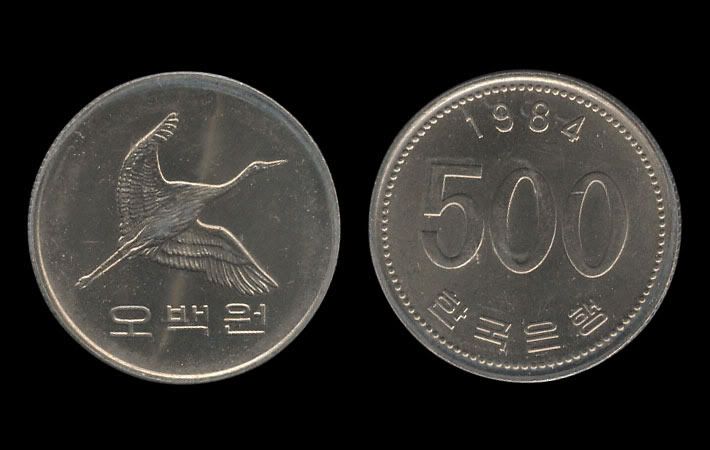
EDITED: I'm not super comfortable with 100% plagiarism anymore, especially since this post gets a lot of hits from others who think the 500 won coin looks like a mockingjay (or thus sayeth the google search keywords that link to me!) so please read the rest of the article here! It's super info-tastic.  http://seoulistic.com/just-for-fun/get-to-know-faces-youll-see-everyday-in-korea-whos-on-south-korean-money/#

P.S. I think that the red crowned crane on the 500 won coin looks like a Mockingjay, don't you??

See?

Sunday, May 20, 2012

May 18 Massacre

I meant to post about this on Friday, which actually was May 18, but I forgot in my haste to get to Seoul for the weekend!  I had a ton of fun, by the way, hanging out with good friends and checking out the Lantern Festival/Parade to honor Buddha's Birthday, which is coming up.  I'll post about that later!  Right now, I am exhausted but I still wanted to post a little about May 18 for the record, while it's still fresh on my mind.  

Photos from the May 18 Memorial Park
 
The May 18 Massacre refers to the 10 day uprising in Gwangju that began on May 18, 1980.  Gwangju being my city and all, I have heard about the uprising quite a bit.  In fact, when I was preparing to move here, I googled “Gwangju” and that was just about the first thing that I read.  My mom and dad weren’t exactly thrilled to hear that their baby daughter’s new city was most famous for a major massacre of close-to-my-age students, even if it was 30 years ago, but (lucky for me) they got over it ;)

A little background about the tragedy:  South Korea was dominated by a series of martial dictators for most of the post-war 20th century.  You’d think the US would have helped set up some democracies in its role as anti-communist world power during the Cold War, but internationally we were unfortunately more anti-communism than we were pro-democracy, so we mostly seemed to support pro-US dictators around the world at that time.  Such was the case in South Korea.  We stepped in to stop communism, but didn’t step in so far as to demand democracy for the newly formed South Korean government.  

One of those pro-US dictators was President Park Chung-hee.  Park ruled for 18 years before he was assassinated in October of 1979.  With his assassination, pro-democratic-leaning demonstrators began a movement that was squelched by a coup-de-tat a few months later when President Chun Doo-hwan took brutal control of the government.  Chun responded to the pro-democracy student movement with harshly enforced martial law, closing universities all around South Korea.  Students in Gwangju protested the university closings at Chonnam National University.  That’s where things heated up on May 18, 1980.  

President Chun (allegedly with the support of the US) reassigned DMZ paratroopers to Gwangju to suppress the student demonstration there at Chonnam.  The soldiers and students clashed and the fighting only got more intense as the paratroopers used unnecessary force (bayonets versus stones?) and the city rallied around its students.  The next ten days were horrific for the civilian population and I’ve read that there were between 200 casualties (the number released by Chun’s government) up to 2,000 (the number estimated today) by the end of the massacre.  


The Gwanju Uprising ended in tragedy (ergo the “massacre” label), but residents of Gwangju take great pride in their city’s role to support democratic government in South Korea.  The Gwangju Uprising may have been a defeat, but history proves that their sacrifice left a great legacy. 

The Gwangju Uprising gave birth to the national struggle for democracy in South Korea after decades of dictatorships following the Korean War. The spirit and legacy of the Gwangju Uprising resonates today with Koreans all over the world in the global movement for democracy and human rights.